Welcome

Welcome to my self-indulgent location for the stories (good and bad) that I can't prevent myself from writing. All comments and criticisms welcome. I post on Tuesdays and Saturdays.
Showing posts with label emotions. Show all posts

Friday, February 25, 2011

In Celebration of the Anglo-Saxon Loogie

Last week I participated in the Bernard Pivot Blogfest, hosted by Nicole Ducleroir at One Significant Moment At A Time. The blogfest was a huge success, with around 150 participants, not to mention being great fun. Thanks, again, to Nicole for hosting!

One of the questions, though, got me thinking.

What is your least favorite word?
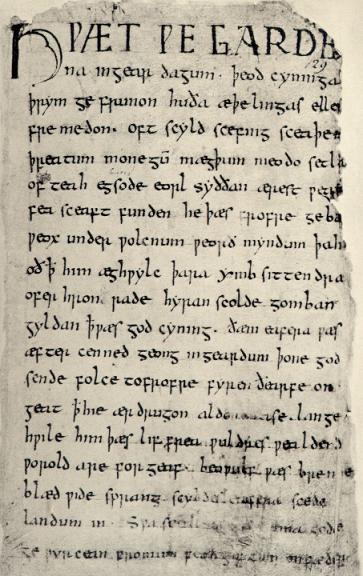
The first page of Beowulf; courtesy of Wiki Commons
Some common words included:
  • moist (I think this was the most common)
  • some assorted swear words
  • vain/vein
  • flesh
  • can't
  • sorry
  • lush
  • breath/breathe
  • no
  • hate
  • maybe
  • snot
  • glowered
  • chuckle

And, I had a short conversation with Leigh over email discussing the "loogie-like" quality of one of my FAVORITE words: slew. I still defend my word, whether it will involve a big wad of spittle or not!

Okay, besides the negative connotations with many of these words, most of them have something else in common. With the exception of moist (which I will NOT defend), vain and lush, these words all have Germanic/Old English roots (okay, well, technically glower might have been borrowed really early from Old Scandinavian, but it's not French, okay?)

Why do we oppose our strong Anglo-Saxon linguistic roots? Favorite words included those pulled from Greek, Latin, French, Spanish (one of mine was Yiddish, but I suppose we shouldn't look at mine, eh?).

My writing teacher last semester repeatedly said, "If there's something you can say with an Anglo-Saxon word, use it." And I agree. Otherwise it can sound pretentious (which is from French) or, perhaps, highfalutin.

An example, perchance:
The monarch's confidant departed for foreign countries, carrying beautiful presents of silver and gold.
Compare:
The king's friend left for far-away lands, bearing shimmering gifts of silver and gold.
Now, how do these different sentences make you feel? Does the second inspire more emotion? Can you imagine the situation better/differently? With a couple exceptions, the words in the first example have foreign roots, and the words in the second have Anglo-Saxon roots.
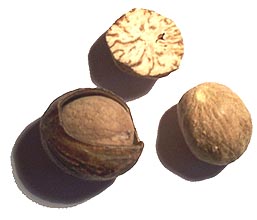
Nutmeg seeds; courtesy of Wiki Commons
This may not be a popular view, but I think native English speakers have stronger associations with Anglo-Saxon vocabulary than other vocabulary (and I restrict this to native-English speakers only because I cannot speak from another view point). Other words are colorful, perhaps even more poetic, but they are the spices of our writing dish. You're not going to open your spice cabinet and eat the entire tub of Nutmeg, are you? (It's toxic in high doses! Don't do it!)

We shouldn't do that with our language, either.

Enjoy the meat, and flavor lightly.

And if it means talking about a slew of loogies instead of copious saliva then so be it :)

Do you agree? What's your favorite Anglo-Saxon word? Not sure if your word's Anglo-Saxon? Check here.

Saturday, September 18, 2010

Emotions Recap

Thanks to everyone for participating in my forum earlier this week, and my apologies for not getting results up sooner.  The week slipped away from me again.  Pesky days!

The question was: as writers, where do we mine our emotions?  From ourselves? From others?  If from others, why don't we work with our own?

You gave me lots of good responses, a number of which said that emotions came from inside and outside of themselves.  This makes sense, of course.  I think it would be impossible for someone to write completely outside of their own emotional experiences.  Of course, some of the physical experiences are beyond us (as Hart said, she's never randomly found a dead body even though she's writing her cozy), but that doesn't prevent the emotions from being real.  They just come from somewhere else.

One of the things I tend to worry about in my writing is that people will automatically assume it's autobiographical in some form.  (Random connection:  Has anyone read "The Young Painters" by Nicole Krauss in the 20 under 40 issue of The New Yorker?)  So I tend to try pulling from other experiences so that I can be more assured when fighting against those comments. 

Beyond outside criticism, using our own experiences does mean dealing with those feelings and emotions.  As j.leigh pointed out, that can be extremely difficult for us, throwing our real pain into our writing.  If I did more of that myself, I don't think I would ever finish a piece because I would be too angry or crying too much to get the words onto the page!  It doesn't make the emotions we use any less real, but it gives us more of an external position from which to approach them.  And as Amanda said, with time, using our own emotions and experiences can become less frightening.

Finding emotion everywhere is vital, since we've only lived in our small worlds.  But we shouldn't be afraid of using our own.

Any other thoughts?  Did I miss anything?
Related Posts with Thumbnails