
One of the questions, though, got me thinking.
What is your least favorite word?
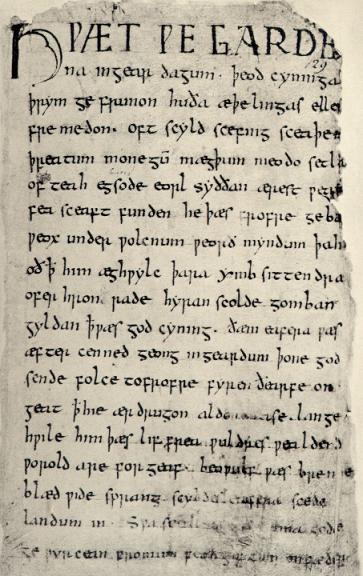 |
| The first page of Beowulf; courtesy of Wiki Commons |
- moist (I think this was the most common)
- some assorted swear words
- vain/vein
- flesh
- can't
- sorry
- lush
- breath/breathe
- no
- hate
- maybe
- snot
- glowered
- chuckle
And, I had a short conversation with Leigh over email discussing the "loogie-like" quality of one of my FAVORITE words: slew. I still defend my word, whether it will involve a big wad of spittle or not!
Okay, besides the negative connotations with many of these words, most of them have something else in common. With the exception of moist (which I will NOT defend), vain and lush, these words all have Germanic/Old English roots (okay, well, technically glower might have been borrowed really early from Old Scandinavian, but it's not French, okay?)
Why do we oppose our strong Anglo-Saxon linguistic roots? Favorite words included those pulled from Greek, Latin, French, Spanish (one of mine was Yiddish, but I suppose we shouldn't look at mine, eh?).
My writing teacher last semester repeatedly said, "If there's something you can say with an Anglo-Saxon word, use it." And I agree. Otherwise it can sound pretentious (which is from French) or, perhaps, highfalutin.
An example, perchance:
The monarch's confidant departed for foreign countries, carrying beautiful presents of silver and gold.Compare:
The king's friend left for far-away lands, bearing shimmering gifts of silver and gold.Now, how do these different sentences make you feel? Does the second inspire more emotion? Can you imagine the situation better/differently? With a couple exceptions, the words in the first example have foreign roots, and the words in the second have Anglo-Saxon roots.
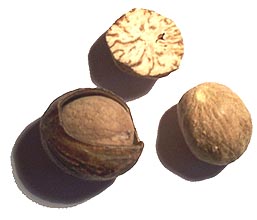 |
| Nutmeg seeds; courtesy of Wiki Commons |
We shouldn't do that with our language, either.
Enjoy the meat, and flavor lightly.
And if it means talking about a slew of loogies instead of copious saliva then so be it :)
Do you agree? What's your favorite Anglo-Saxon word? Not sure if your word's Anglo-Saxon? Check here.


7 comments:
The nerdy linguist in me loves this post. :D
So far it seems my favourite words are all from Latin or French. Vivacious. Vivid. Zest.
Ha! Leave it to you, Linguist Extraordinaire, to scrutinize writing/novels based on the ORIGINS of words. Very interesting! Now I'm curious as to which I use, or what the percentage is. ;o)
Have a great weekend, Rosie!
Interesting post! The least favourite words posted are ones I only mind when they are over-used in writing, and I completely agree with your writing teacher.
Okay -- this would never have crossed my mind, but it's so interesting :)
My favourite word for the sound of it is discombobulated ... and apparently it is anglo saxon!
LOL! I was reading a magazine w/my 7 yr-old yesterday and it said "moist lips" and she goes, "Ewww!"
I swear, I didn't tell her! :D
And I'll skip the nutmeg, but I love the shimmer. Please stop evoking mucus... :D
I love lots of lost words that do get plunked into my stories.
I love old english - old french - I am always lost in the spellings and word use and have to be careful not to write it ---
divers - diverse
Spell check won't catch my wandering - lol
I love the way english is so easy to play with - we constantly invent new words or use them in whole new ways -
Great post - I think that first question was one of the hardest - for word love is not a very loyal sort of adoration to me - I am a playgirl in words and any are likely to catch my eye if they are pretty.
Now on a side note - growing up I had a band director who taught us that A Looby (relative to Loogie) was the nasty spit blob you let out of your horn from time to time to keep it from sounding like a near dead cow. One year he took innocent little us out into the world and made s eat at a cafeteria - It was called
Luby's
It is amazing how delicate our teen hunger became - amazing what you can make your mind believe with just a word.
Post a Comment